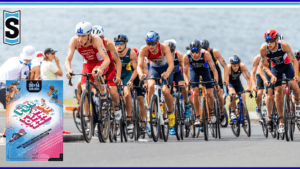
The French Triathlon Federation is taking a new step in its development strategy. By launching the first edition of the “Triathlon Festival”, from June 8 to 14, the federal body wishes to create an annual meeting capable of simultaneously uniting its network of clubs around the same objective: to introduce as many people as possible to the linked disciplines and their values.
The operation takes place in a particularly favorable context. For several years, triathlon has enjoyed growing popularity in France. The federation claims nearly 74,000 licensees in 2026 and more than 220,000 practitioners having subscribed to an experience license for one day in 2025. Figures which testify to a reinforced attractiveness, driven in particular by the Olympic and Paralympic visibility of the discipline, but also by the evolution of sporting practices towards greater versatility, the outdoors and the search for well-being.
For the FFTri, the challenge goes far beyond the framework of a simple week of activities. This new operation should make it possible to build a coherent path between discovery, regular practice and associative commitment. The ambition is to transform occasional interest in the discipline into lasting membership within clubs, which constitute the main engine of territorial development.
More than 1,000 clubs mobilized
The system will essentially be based on the mobilization of the federal network. More than a thousand clubs spread across the entire territory will be invited to organize initiations, educational workshops, sports-health events or even friendly meetings intended for all audiences.
The federation has voluntarily left broad freedom of organization to local structures so that they can adapt their actions to the realities of their territory. Each club will thus be able to build its own program while falling within a common federal framework. The objective is to increase the opportunities for contact between practitioners and non-practitioners in a logic of proximity.
“These shared moments remind us that sport is a wonderful vector of social bond and transmission of values,” underlines the president of the French Triathlon Federation, Cédric Gosse, who hopes to see this event establish itself permanently in the federal calendar.
A promotional tool for an inclusive discipline
The “Triathlon Festival” will also serve as a showcase for the diversity of disciplines grouped within the federation. Beyond the traditional triathlon, the clubs will highlight para triathlon, duathlon, aquathlon, swimrun, bike and run and even multisport raids.
This diversity constitutes one of the main assets of the discipline. By combining swimming, cycling and running, triathlon offers a complete practice while remaining adaptable to very varied profiles. The federation also emphasizes its ability to welcome practitioners of all ages and levels, as well as the fully integrated place of para triathlon within the federal movement.
Through this first edition, the FFTri therefore intends to remind people that the triathlon is not just an endurance practice reserved for a sporting elite. By widely opening its clubs and activities, it seeks on the contrary to demonstrate that linked disciplines can constitute a tool for health, education and social cohesion accessible to as many people as possible.
A.J.
PakarPBN
A Private Blog Network (PBN) is a collection of websites that are controlled by a single individual or organization and used primarily to build backlinks to a “money site” in order to influence its ranking in search engines such as Google. The core idea behind a PBN is based on the importance of backlinks in Google’s ranking algorithm. Since Google views backlinks as signals of authority and trust, some website owners attempt to artificially create these signals through a controlled network of sites.
In a typical PBN setup, the owner acquires expired or aged domains that already have existing authority, backlinks, and history. These domains are rebuilt with new content and hosted separately, often using different IP addresses, hosting providers, themes, and ownership details to make them appear unrelated. Within the content published on these sites, links are strategically placed that point to the main website the owner wants to rank higher. By doing this, the owner attempts to pass link equity (also known as “link juice”) from the PBN sites to the target website.
The purpose of a PBN is to give the impression that the target website is naturally earning links from multiple independent sources. If done effectively, this can temporarily improve keyword rankings, increase organic visibility, and drive more traffic from search results.