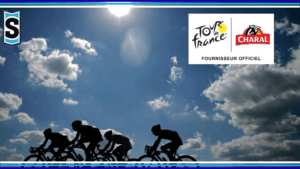
The Tour de France continues to attract brands from sectors well beyond sport. By formalizing its arrival at the most followed cycling event in the world, Charal signs a very large-scale visibility operation. Every summer, the Grande Boucle boasts nearly 14 million spectators on the roadside and broadcast in nearly 200 countries. For a consumer food brand, it is difficult to find a more powerful platform to combine proximity, volume of exposure and popular incarnation.
The announcement comes in a symbolic context for Charal, which will celebrate its forty years in 2026. Since its creation in 1986, the brand has built its notoriety around a simple positioning: democratizing beef through accessible, industrialized products but strongly identified with the French sector. Like his arrival at the FISE https://www.sportstrategies.com/charal-ride-avec-le-fise/This entry into the Tour de France is therefore part of a logic of continuity rather than rupture. After activations on the Vendée Globe, the Route du Rhum, the Salon de l’Agriculture or several summer festivals, Charal is continuing its strategy of physical presence in direct contact with the public.
A popular and territorial platform
The choice of the Tour de France meets several simultaneous objectives. First, that of media exposure. The advertising caravan remains one of the most powerful marketing devices in the French events landscape. More than 150 vehicles cover several thousand kilometers each summer in front of family crowds who are particularly receptive to brand events. For advertisers, the interest goes far beyond the simple distribution of goodies: the Tour makes it possible to create an extremely strong emotional bond with consumers.
For Charal, the issue is also territorial. The brand emphasizes its eight production sites spread across France as well as its 30,000 partner breeders. At a time when food manufacturers are regularly questioned about the origin of products, the Tour offers a platform for expression consistent with the local discourse that the company wishes to convey. Every year, the Grande Boucle passes through medium-sized towns, rural areas and agricultural areas, precisely the geographical heart of the French beef industry.
The partnership also allows Charal to more concretely install its new communication platform around the “Vivons Fort” signature. The message developed by the brand now associates beef more with energy, conviviality and the notion of pleasure. In a context where meat consumption is gradually declining in France due to environmental and health concerns, the objective is clear: to put emotion and experience back at the center of speaking out.
The activation planned for the Tour reflects this orientation. The brand is announcing a strongly scripted caravan, faithful to its historic advertising tone mixing self-deprecation and popular codes. Tastings, activities and gift distributions will accompany each stage, while a traveling barbecue will be deployed in the departure areas. A way of transforming the partnership into a sensory and festive experience rather than simple media visibility.
The Tour confirms its commercial power
The arrival of Charal once again illustrates the ability of the Tour de France to attract brands from the general public food sector. In a fragmented advertising environment, where television audiences are dispersed and where digital acquisition costs are exploding, the Grande Boucle retains a rare asset: a massive, intergenerational and free audience.
For Amaury Sport Organization, owner of the event, the advertising caravan remains a strategic economic asset. It not only constitutes an important source of income, but also a constituent element of the popular experience of the Tour. Some brands even build an essential part of their sympathy capital there. Cochonou, Le Gaulois, Haribo and even Krys have demonstrated over the years that a regular presence on the caravan can permanently anchor a brand in the collective imagination.
Charal will now seek to join this category of advertisers immediately associated with the Tour. The challenge will be to transform an anniversary operation into a lasting partnership. Because beyond summer visibility, the challenge is also to strengthen the desirability of a historic brand in a food market under pressure, where consumer decisions are increasing.
A.J.
PakarPBN
A Private Blog Network (PBN) is a collection of websites that are controlled by a single individual or organization and used primarily to build backlinks to a “money site” in order to influence its ranking in search engines such as Google. The core idea behind a PBN is based on the importance of backlinks in Google’s ranking algorithm. Since Google views backlinks as signals of authority and trust, some website owners attempt to artificially create these signals through a controlled network of sites.
In a typical PBN setup, the owner acquires expired or aged domains that already have existing authority, backlinks, and history. These domains are rebuilt with new content and hosted separately, often using different IP addresses, hosting providers, themes, and ownership details to make them appear unrelated. Within the content published on these sites, links are strategically placed that point to the main website the owner wants to rank higher. By doing this, the owner attempts to pass link equity (also known as “link juice”) from the PBN sites to the target website.
The purpose of a PBN is to give the impression that the target website is naturally earning links from multiple independent sources. If done effectively, this can temporarily improve keyword rankings, increase organic visibility, and drive more traffic from search results.