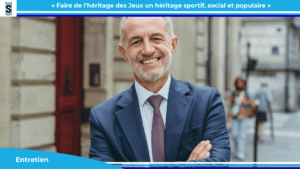
The JOPs left their mark on Paris 2 years ago. How do you plan to transform this Olympic momentum into sustainable public policies for the sporting practice of Parisians?
The 2024 Paris Olympic and Paralympic Games were a real success and helped make our capital the world capital of sport. The Games also made it possible to renovate numerous sports facilities such as the Dauvin Sports Center, Poissonniers, etc. And to build new facilities for local sports: the Adidas Arena, Porte de la Chapelle. The water quality of the Seine has been improved to create a new place for sports: swimming in the Seine. We intend to pursue this ambition and make the legacy of the JOPs a sporting, social and popular legacy. To do this, we are going to perpetuate the district Olympics and make sport a popular celebration all year round thanks to major inter-school games. We also plan to open a new swimming site: the Plage de la Bastille at the port of l’Arsenal.
In your program, you insisted on the role of sport as a lever for public health. Concretely, how can a town hall act to fight against a sedentary lifestyle in a dense city like Paris?
The fight against a sedentary lifestyle involves, on the one hand, the development of infrastructure allowing everyone to move around actively (pedestrianization, widening of sidewalks, cycling facilities, etc.). In order to encourage everyone to practice regular physical activity, we will increase the number of “sport and health centers” so that there is one in each district to combat a sedentary lifestyle. We will also ensure the sporting activity of seniors by amplifying free municipal schemes (Paris senior sport, senior outdoor sport, etc.) in conjunction with sports associations and EHPADs.
Another subject, Paris is a very constrained city in terms of land. How do you really plan to increase the capacity for sports activities when available land is rare? Is the equation solvable?
To continue to encourage sports practice for all, we will work on the proper use of slots and available spaces (raising heights, sharing spaces with schools, etc.). Regarding practice locations, we will develop the raised construction of new rooms such as the Suzanne Liebrard gymnasium in the 12th or the future Cité des sports in the 20th. We will go further by increasing the number of practice locations through the pooling of spaces with high school and college sports facilities or even with the transformation of unused office space into dance rooms, boxing rooms or dojos. Our objective is clear: we will invest heavily in public spaces in order to encourage the practice of sport by everyone, everywhere and all the time. In addition, in line with our city’s climate ambition, we will invest significantly in the renovation of existing equipment in order to improve the comfort of users.
Your program evokes the transformation of public space into a place for sporting activities (running, street workout, urban sports). How can we reconcile these uses with the other functions of public space in an already very dense city?
The development of public space, particularly pedestrianization, already encourages the practice of sport. We are going to continue this dynamic in favor of pedestrians, which is also of great benefit to athletes: running, cycling, street workouts, etc. We are going to continue this dynamic by creating the large banks of the Seine: 25 km of continuous, green and accessible walking on both banks. In addition, we will also install sports markings on the ground in streets, schools and pedestrian streets. We will invest heavily in public spaces in order to encourage the practice of sport by everyone, everywhere and all the time. We will take into account the different uses depending on the time of day (chronotopia) to arrange the public space in favor of sports practices. This could be, for example, a street closed in the middle of the day for school sports.
You propose increasing aid to finance children’s sports licenses. In a constrained budgetary context for communities, how can this measure be financed sustainably?
Purchasing power is a top priority. A sports license costs on average €360 per child, per year. Given this reality, paying for one sports license per year would reduce inequalities and promote access to sports practice. This is a public health issue. We therefore plan to increase the “sports discount” envelope and strengthen the free municipal offer or with social pricing aimed at the most vulnerable groups (young people from the ASE, users of accommodation centers, families from social centers, etc.).
You also emphasize the central role of sports associations and volunteering. How can the City of Paris better support this associative fabric which often constitutes the heart of amateur sport?
Amateur sport is mainly based on associations in Paris and we support this associative fabric. We will facilitate their access to slots and municipal buildings for meetings or the organization of sporting events. Financial stability is an essential condition for associative structures: we will ensure visibility to associations through multi-year objectives agreements and we will create an emergency fund for associations in difficulty. Finally, to support the professionalization of structures, we will offer a free training course for volunteer leaders.
You want to double the slots dedicated to women’s teams in sports facilities. How do you plan to practically apply this measure when the slots are already hotly contested?
Sports practice is a factor of emancipation and must be encouraged in Paris. To continue our action in favor of women’s sport, we will propose a plan dedicated to the practice of women’s sport. To do this, we will ensure that there are many more slots for women’s teams. We will also ensure that we set objectives in the association objective agreements.
What about the Parc des Princes file? In your program, you mention a transformation of the neighborhood around the Parc des Princes with an expanded stadium and new urban development. What exactly is your position on the future of the stadium: should the City retain ownership of the Park or are you open to a sale to the club, contrary to the line defended by Anne Hidalgo in recent years?
My position is clear: PSG must stay at the Parc des Princes. Discussions about the sale may resume after his election. This decision will be submitted to the Paris Council, whose members are elected by citizens. I am in favor of selling the park to the PSG club. The money from the sale can then be redistributed to support the development of local sport. This sale will be accompanied by a transformation of the surroundings of the Park, with the massive revegetation of the Porte de Saint-Cloud and the partial covering of the ring road to create a large green and pedestrianized space, accessible to all.
Finally, what is the right mix in terms of sports policy? The city already hosts Roland-Garros, but also other events at the Parc des Princes, Accor Arena and the Adidas Arena. What do you think the capital’s sports strategy should be: attracting more major international events or investing primarily in everyday sport?
We will not choose between major events and local sport: we will invest in both. We will continue to host major events that contribute to the influence of our city. We will also give access to these emblematic places to Parisians by facilitating, in particular, the access of children and young people to the facilities hosting major competitions and we will apply for the Youth Olympic and Paralympic Games in order to further democratize the practice of sport at all ages. Finally, we will also organize popular, free and recurring sporting events: canoe trips down the Seine, sporting events on the Champs-Élysées, etc.
Interview conducted by Alexis Vénifleis
PakarPBN
A Private Blog Network (PBN) is a collection of websites that are controlled by a single individual or organization and used primarily to build backlinks to a “money site” in order to influence its ranking in search engines such as Google. The core idea behind a PBN is based on the importance of backlinks in Google’s ranking algorithm. Since Google views backlinks as signals of authority and trust, some website owners attempt to artificially create these signals through a controlled network of sites.
In a typical PBN setup, the owner acquires expired or aged domains that already have existing authority, backlinks, and history. These domains are rebuilt with new content and hosted separately, often using different IP addresses, hosting providers, themes, and ownership details to make them appear unrelated. Within the content published on these sites, links are strategically placed that point to the main website the owner wants to rank higher. By doing this, the owner attempts to pass link equity (also known as “link juice”) from the PBN sites to the target website.
The purpose of a PBN is to give the impression that the target website is naturally earning links from multiple independent sources. If done effectively, this can temporarily improve keyword rankings, increase organic visibility, and drive more traffic from search results.