The document arrives in a context of budgetary tension, crisis in the healthcare system and explosion of disorders linked to a sedentary lifestyle. His message is clear: France spends enormously to repair the health consequences of harmful lifestyles, but very little to transform the environments that produce them. Today, less than 3% of health spending is devoted to prevention. At the same time, 95% of adults are at risk of deterioration in their health linked to a lack of physical activity and too much time spent sitting.
A generation that no longer moves
The figures compiled in the report paint a worrying picture. France ranks 119th in the world out of 146 countries regarding physical activity among adolescents. Only 34.2% of sixth grade students have a level of endurance considered satisfactory. In thirty years, the cardiovascular capacities of children and adolescents have decreased by around 25%.
The report establishes a direct link between this physical degradation and everyday modes of travel. Home-school journeys, often less than two kilometers, are still mainly made by car. The authors describe a society which has gradually removed all physical activity from ordinary actions: going to work, doing your shopping, accompanying your children or reaching a train station no longer require any physical effort.
This silent transformation produces massive effects on public health. Physical inactivity is now considered the fourth leading cause of premature mortality worldwide. The consequences affect cardiovascular diseases, type 2 diabetes, certain cancers, but also mental health.
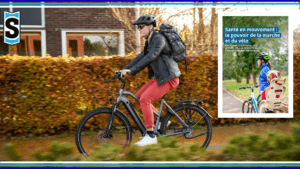
The report recalls that a relatively modest practice of cycling is already enough to produce measurable effects. One hundred minutes of cycling per week reduces all-cause mortality by 10%. Regular practice reduces cardiovascular risks by 40% and those linked to type 2 diabetes by 20%. In France, cycling would have helped prevent nearly 2,000 premature deaths and 6,000 chronic illnesses in a single year.
The interest of the bicycle, in this logic, lies in its banality. It requires no subscription, no specific niche, or any particular organization. It reintroduces physical activity into the very fabric of the day.
Cycling, a new mental health issue
The report also emphasizes a point that is still little integrated into public policies: the impact of active mobility on psychological health. In a France where nearly one in five adults suffer from anxiety or depressive disorders, walking and cycling appear to be powerful preventative levers.
According to the studies cited, 69% of people practicing regular physical activity notice positive effects on their mental well-being and a reduction in stress. Active travel improves sleep, reduces anxiety and promotes concentration. Among young people, they are associated with better academic results and better psychological balance.
This dimension goes far beyond the sporting framework. The report describes the bicycle as a tool for re-appropriating everyday life in societies marked by isolation, screens and automobile confinement. The movement ceases to be a simple time undergone; it once again becomes a moment of autonomy, of exposure to reality, of mental breathing.
A climate policy that also benefits health
The FUB document is based on a simple idea: active mobility makes it possible to deal with several major crises simultaneously. Health, pollution, climate, energy dependence, urban congestion and social inequalities are becoming linked issues.
Transport today represents 31% of French greenhouse gas emissions, 97% of which come from road transport. According to ADEME, up to 25% of kilometers traveled could be done by bike, which would reduce travel-related emissions by 31%, or around 17 million tonnes of CO₂ avoided each year.
The health gains linked to air quality are just as important. Air pollution remains associated with around 40,000 premature deaths annually in France. As for road noise, considered by the WHO to be the second most harmful environmental factor after air pollution, it contributes to 48,000 new cases of cardiovascular disease and 12,000 premature deaths each year in Europe.
The report also highlights the current political contradiction. Even though the benefits of active mobility are increasingly better documented, national funding is declining. The Cycling and Walking Plan, launched in 2023 with an announced envelope of 250 million euros annually, suffered significant budgetary reductions from 2024. In 2025, less than a fifth of the promised co-financing had actually been committed by the State.
The FUB report then formulates a fundamental criticism: France continues to consider prevention as an optional expense, even though it probably constitutes one of the most profitable public investments in the long term. Behind the question of cycling, a much broader trade-off finally emerges: continue to finance essentially the repair of diseases, or invest more in environments capable of producing less.
A.J.
PakarPBN
A Private Blog Network (PBN) is a collection of websites that are controlled by a single individual or organization and used primarily to build backlinks to a “money site” in order to influence its ranking in search engines such as Google. The core idea behind a PBN is based on the importance of backlinks in Google’s ranking algorithm. Since Google views backlinks as signals of authority and trust, some website owners attempt to artificially create these signals through a controlled network of sites.
In a typical PBN setup, the owner acquires expired or aged domains that already have existing authority, backlinks, and history. These domains are rebuilt with new content and hosted separately, often using different IP addresses, hosting providers, themes, and ownership details to make them appear unrelated. Within the content published on these sites, links are strategically placed that point to the main website the owner wants to rank higher. By doing this, the owner attempts to pass link equity (also known as “link juice”) from the PBN sites to the target website.
The purpose of a PBN is to give the impression that the target website is naturally earning links from multiple independent sources. If done effectively, this can temporarily improve keyword rankings, increase organic visibility, and drive more traffic from search results.