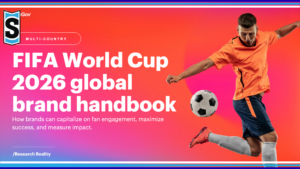
YouGov unveils its Global Brand Manual on fan engagement and the real impact of sponsorship in the run-up to the 2026 World Cup. The purpose of the report is simple: help brands understand audiences, optimize their sponsorship strategies and measure the real impact of their activations.
The event starts well before the first match
We must get rid of a reflex that is still too widespread according to the document: considering the World Cup as a four-week sprint. In view of the conclusions of the YouGov study, the tournament already acts as a cultural and commercial accelerator, well before kick-off. The level of “buzz” measured in the host countries also exceeds that observed during the same period before the 2022 World Cup, with notable progress in the United States and Mexico.

This time gap changes the nature of competition between brands. The first benefits are no longer conditioned on visibility during matches, but on the ability to be part of the rise of the phenomenon. This is particularly visible on activations like that of Airbnb, whose usage intention almost doubled among engaged fans after the announcement of its dedicated accommodation program.

Another structuring development: the 2026 World Cup goes far beyond the historical base of football fans. 42% of the world population says they want to follow the competition, well beyond the core of football fans. Clearly, the event captures an opportunistic audience, less expert but very reactive to marketing signals.
A young, attentive and active audience
The audience profile confirms a shift in the center of gravity. World Cup fans are younger, more educated and have above-average incomes. In North American markets, this dynamic is even more pronounced: in the United States and Canada, football followers are significantly younger than the general population, which constitutes an anomaly in the local sports ecosystem.

This youth is not only demographic, it is behavioral. 18-34 year olds don’t just watch: they interact. 66% of them say they pay attention to sponsors, compared to 51% of those over 35. And above all, they transform this attention into action. They are more likely to test a brand, recommend it or pay more when it is associated with the competition.
This point deserves to be underlined: the effectiveness of sponsorship is no longer a hypothesis. It is measured. Nearly one in two fans say they have a more positive perception of a brand involved in the World Cup. In some markets, this rate exceeds 70%. Sponsorship acts on trust, desirability and the propensity to purchase.
But this effectiveness is based on specific conditions. First, visibility. Television remains a major channel (43% memorization), but social networks follow very closely (41%) and dominate among the youngest. Then, the ability to create tangible touchpoints: on-site experiences, shareable content, promotional offers. In the United States, more than one in two fans believe they “deserve” concrete benefits from sponsors.
Finally, there is an element that is often underestimated: the social dimension of the event. The 2026 World Cup is experienced in groups. Meet up, consume, publish, wear colors. The activations that work are those that fit into these collective moments. The match is just an anchor; the experience is built around it.
A hierarchy of brands already installed
The battle for memorization is also widely engaged. Coca-Cola clearly dominates spontaneous recognition of sponsors with 46%, ahead of Adidas and Visa. Nothing surprising, but the gap underlines a key point: in a saturated environment, consistency pays more than one-off hits.

The case of Kia in 2022 or that of Michelob Ultra ahead of 2026 illustrate another reality: the impact is not uniform. It depends on the context (teams in the final, muses, campaign timing) and the ability to activate at the right time In other words, sponsorship is not a passive lever here. It is a system to be orchestrated.

One thing is certain: North America is in the process of making a lasting shift into a football culture that was until now only emerging.
Alain Jouve
PakarPBN
A Private Blog Network (PBN) is a collection of websites that are controlled by a single individual or organization and used primarily to build backlinks to a “money site” in order to influence its ranking in search engines such as Google. The core idea behind a PBN is based on the importance of backlinks in Google’s ranking algorithm. Since Google views backlinks as signals of authority and trust, some website owners attempt to artificially create these signals through a controlled network of sites.
In a typical PBN setup, the owner acquires expired or aged domains that already have existing authority, backlinks, and history. These domains are rebuilt with new content and hosted separately, often using different IP addresses, hosting providers, themes, and ownership details to make them appear unrelated. Within the content published on these sites, links are strategically placed that point to the main website the owner wants to rank higher. By doing this, the owner attempts to pass link equity (also known as “link juice”) from the PBN sites to the target website.
The purpose of a PBN is to give the impression that the target website is naturally earning links from multiple independent sources. If done effectively, this can temporarily improve keyword rankings, increase organic visibility, and drive more traffic from search results.