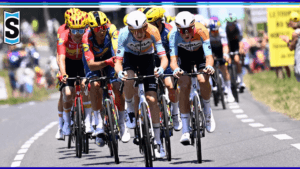
Every summer, the Tour de France takes its place in the French landscape with an almost heritage regularity. The event has long gone beyond the strict framework of cycling competition. It is at the same time a sporting spectacle, a national soap opera, a showcase of the territories and a rare media event, capable of bringing together very large audiences in an environment where attention is becoming increasingly difficult to capture.
The figures from TGI France 2026 R1 clearly show this. In France, 15.8 million people say they are interested in the Tour de France, or nearly three in ten French people aged 15 and over. This critical mass already constitutes a major argument. But the interest of this audience is mainly due to its composition. Men represent 67% of Tour fans, with an index of 139 compared to the French population. The most mature generations are also over-represented: baby boomers, aged 62 to 80, make up 42% of this audience, for an index of 134. The average age reaches 52, which places the Tour in a very specific register: that of a loyal, established, available and strongly attached audience to major sporting events.

This maturity is in no way a hindrance for brands. On the contrary, it draws a solid, solvent and often prescriptive target. The wealthy categories represent 19% of Tour de France fans, compared to 15% in the entire French population, an index of 129. Behind the popular image of the caravan, the roadsides and summer afternoons in front of the television, the Tour therefore brings together an audience with high consumption potential. It is precisely this mix between popular roots and socio-economic value that makes it unique in the market for rights, sponsorship and brand activations.
An audience that doesn’t just watch sport
One of the most interesting lessons from the study relates to the very concrete relationship that Tour fans have with sporting practice. The public at the Grande Boucle is not just spectators. He lives sport every day, integrating it into his habits, his leisure activities and his purchases. Tour enthusiasts clearly outperform in terms of bike ownership, with an index of 132, sports practice, with an index of 126, and even more in outdoor sports, where the index reaches 154.

This proximity to the effort gives the Tour a particular strength. The disciplines most practiced by this target, from road cycling to mountain biking, including cycle touring and running, directly extend the imagination of the event. The Tour is not experienced as a simple television program. It echoes real practices, a culture of endurance, progression, the outdoors and surpassing oneself. For equipment manufacturers, distributors, nutrition brands, sports tourism players or communities, this affinity gives depth to speeches.
Purchasing behavior confirms this intensity. According to TGI France, 35% of Tour de France enthusiasts have purchased sports clothing over the last twelve months, compared to 29% of the French population, i.e. an index of 122. They are also 7% who regularly buy their sports equipment online, with an index of 148. This figure, which may seem contained in volume, on the contrary signals a clear over-representation of active buyers, accustomed to transforming their sporting interest into consumption. In a context where brands seek to link exposure, preference and conversion, this data matters.

The emotional connection to sport further reinforces the value of this audience. Half of Tour fans consider sport to be the spectacle that gives them the most emotion, with an index of 170. This is a particularly high level, which reminds us that sport remains one of the rare contents capable of provoking immediate and collective involvement. 84% follow sports competitions live on television, 63% believe that sport facilitates exchanges with others and 42% enjoy watching competitions with friends. The Tour is fully in line with this logic: it brings people together, it comments on itself, it is shared, sometimes as much for the story as for the result.
A favorable terrain for brands
This emotional intensity partly explains the receptiveness of Tour fans to brand communications. The TGI data underlines a very strong exposure to sports sponsorship: 31% of fans are strongly exposed to it, with an index of 261. The level is high enough to remind us that the Tour de France remains one of the major commercial assets of French sport, not only by its audience, but by the visibility it offers to its partners in a very identified context.
Advertising also benefits from favorable conditions. A quarter of Tour fans say they like advertising in general, with an index of 136, and 24% believe that it helps them make the best purchases, with an index of 137. The Tour offers an environment in which the brand is not necessarily perceived as intrusive, but as an integral part of the show, the story and the experience.
The affinity with automobiles and mobility opens up another field of reading. Tour enthusiasts show a higher than average interest in automobiles, with an index of 137. 28% consider their next vehicle to be ecological, 65% consider the development of charging stations essential and 47% consider that purchasing a French car constitutes a civic act. These data give relief to a territory historically very present around the race. The Tour talks about travel, roads, territories, logistical innovation and environmental impact. For manufacturers, energy companies, charging operators or players in sustainable mobility, the test offers a coherent framework, provided that a credible and concrete message is used.

Finally, the strength of the Tour lies in the diversity of the points of contact that it activates. Fans of the event have a strong affinity with the press, live events, in-store contact, radio and television. This combination gives advertisers a particularly rich omnichannel field. The Tour lives on television, can be listened to on the radio, read in the press, followed on the roads, activated at points of sale and continued on digital platforms. Few sporting events still have such continuity between media exposure, physical experience and consumption.
A.J.
PakarPBN
A Private Blog Network (PBN) is a collection of websites that are controlled by a single individual or organization and used primarily to build backlinks to a “money site” in order to influence its ranking in search engines such as Google. The core idea behind a PBN is based on the importance of backlinks in Google’s ranking algorithm. Since Google views backlinks as signals of authority and trust, some website owners attempt to artificially create these signals through a controlled network of sites.
In a typical PBN setup, the owner acquires expired or aged domains that already have existing authority, backlinks, and history. These domains are rebuilt with new content and hosted separately, often using different IP addresses, hosting providers, themes, and ownership details to make them appear unrelated. Within the content published on these sites, links are strategically placed that point to the main website the owner wants to rank higher. By doing this, the owner attempts to pass link equity (also known as “link juice”) from the PBN sites to the target website.
The purpose of a PBN is to give the impression that the target website is naturally earning links from multiple independent sources. If done effectively, this can temporarily improve keyword rankings, increase organic visibility, and drive more traffic from search results.