You talk about a festival that “brings cycling to life”: what concretely changes in the visitor experience compared to previous editions?
This year, we have really evolved the visitor experience to make it more active and immersive.
In particular, we have created three distinct treasure hunts (family, sports and couples) which allow you to discover the brands in a fun way, through challenges and interactions. The objective is to add a dimension of entertainment, while creating a link with brands. The prize: gifts offered by the brands and the festival.
We have also rethought our way of communicating on site, to better guide visitors. The idea is twofold: to allow those who have a specific need to quickly find the right contacts, and to support Ile-de-France residents in their first bicycle purchases.
Finally, this edition welcomes new players, such as Origine Cycle in the gravel segment, stores like Le Ravito 18 or even urban brands like Pamela Bikes. In total, more than 130 brands will be represented.
 The format with courses, challenges and gamification is central this year: what is the objective behind this more immersive approach?
The objective is to further open the festival to varied audiences.
We don’t come to “see” bikes, but to experience cycling. By offering routes and challenges, we also attract visitors who come first to have a good time and who, naturally, then discover the world of cycling.
It’s also a way of going further with brands: instead of simply presenting a product, we put it in a situation, we talk about its use, we create an experience around it. This completely changes the way visitors perceive and remember brands.
With more than 130 brands present, how do you manage to avoid a simple “trade show” effect to create a real experience?
This is precisely the whole point of Vélo in Paris.
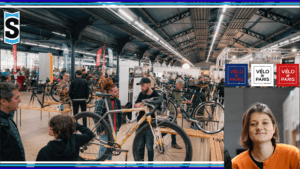
As soon as they enter, visitors understand that they are not in a classic living room. There is a continuous test track, balance bike races, entertainment on the stands, challenges… The festival is in constant motion.
We also work hand in hand with brands to create concrete activations: a treasure hunt with Abus, a ride with Le Ravito 18… The idea is that each interaction leaves a trace.
Our goal is simple: that visitors not only see the brands, but experience and remember them.
The cycling sector is going through a more complex period: how can the event rekindle public desire and commitment?
Indeed, the context is more tense for the sector. But on the ground, public interest is still very present.
We noticed it as soon as registrations opened: in one week, we already had twice as many people registered as the previous year.
The role of an event like Vélo in Paris is to remove the brakes. Testing a cargo bike for the first time, discovering a new practice like gravel, speaking directly with a brand, understanding the solutions against theft… all this allows you to reassure, plan and trigger.

You are banking on a mobile application and digital interactions: what place does technology occupy in the future of the festival?
For us, technology is a lever, not a goal.
Our mission remains to promote cycling and promote its stakeholders. But in an increasingly connected world, we use digital to enrich the experience.
The application allows visitors to easily access the program, participate in treasure hunts, receive information in real time and better orient themselves around the festival.
Ultimately, we want technology to become a tool at the service of brands and visitors, to streamline exchanges and strengthen engagement.
The positioning is very broad (family, sport, duo, urban mobility, etc.): how can we maintain consistency while speaking to all audiences?
It’s an accepted choice: Vélo in Paris is a general event.
The data from our registrations show a very balanced distribution of expectations between urban, sports and leisure cycling (see attached). It’s logical: we are in Paris, a territory where all uses coexist.
Our conviction is simple: practices are not compartmentalized. We try to convince brands as much as possible.
A commuter can become a gravel enthusiast, an athlete can integrate cycling into their daily life.
By bringing these audiences together, we create bridges. And it’s also an economic reality: brands cannot multiply specialized events in each city. Paris therefore becomes a point of convergence.
Vélo in Paris also aims to be a place for meetings and cycling culture: are you looking to become more than an event, almost a media or a platform for the community?
What we want is to best support cyclists and future cyclists. We want to explain, in a fun and interesting way, the added value of brands in the world of cycling. Vélo in Paris is more than an event: we want to make it a real movement, by transmitting our passion.
Comments collected by Alain Jouve
PakarPBN
A Private Blog Network (PBN) is a collection of websites that are controlled by a single individual or organization and used primarily to build backlinks to a “money site” in order to influence its ranking in search engines such as Google. The core idea behind a PBN is based on the importance of backlinks in Google’s ranking algorithm. Since Google views backlinks as signals of authority and trust, some website owners attempt to artificially create these signals through a controlled network of sites.
In a typical PBN setup, the owner acquires expired or aged domains that already have existing authority, backlinks, and history. These domains are rebuilt with new content and hosted separately, often using different IP addresses, hosting providers, themes, and ownership details to make them appear unrelated. Within the content published on these sites, links are strategically placed that point to the main website the owner wants to rank higher. By doing this, the owner attempts to pass link equity (also known as “link juice”) from the PBN sites to the target website.
The purpose of a PBN is to give the impression that the target website is naturally earning links from multiple independent sources. If done effectively, this can temporarily improve keyword rankings, increase organic visibility, and drive more traffic from search results.