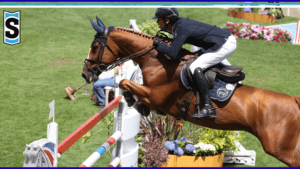
The 65th edition of the Jumping International de La Baule – Official of France will remain as one of the great sporting events of this early summer. For four days, the François-André stadium welcomed more than 45,000 spectators, who came to witness a succession of leading events won in particular by the Swiss Steve Guerdat in the Prix Saur and the Derby de La Baule – Demeures de Campagne, before the victory of the Italian Piergiorgio Bucci in the Rolex Grand Prix Ville de La Baule. But beyond the sporting results, it was the victory of the French team in the Barrière Nations Cup that left its mark.

For Pierre de Brissac, president of the competition for six years, this success of the Blues even constitutes the strongest moment of his mandate. “In six years as president, I had yet to have a memory that really stood out above the others. This French victory instantly became my fondest memory. She was awaited by the public, the riders and the management. The emotion was immense,” he summarizes.
The impact went beyond just the sporting framework. This French performance offered additional media visibility to the event and reinforced the enthusiasm of a public already renowned as one of the most knowledgeable on the international circuit. “La Baule has an exceptional public, respectful of all riders. But seeing France win at home caused a real explosion of joy,” underlines the leader.

A strategy built over the long term
This popular success owes nothing to chance. Since his arrival at the head of the event, Pierre de Brissac has initiated a gradual transformation of the competition, with a simple guideline: improve the experience of all stakeholders without distorting the historical identity of Jumping de La Baule.
Among the structuring decisions is the merger with Rolex, which has become a major partner of the competition. According to the president, this change allowed the event to take a step forward in terms of international notoriety and economic attractiveness. “The arrival of Rolex gave us another dimension and facilitated the arrival of new partners. It’s a ripple effect,” he explains.
Another strategic choice: moving the event to June. A development requested by many riders in order to benefit from better preparation conditions on grass. “The well-being of the horse begins with the quality of the terrain. In June, conditions are better for horses, riders and partners,” recalls Pierre de Brissac.
This attention to infrastructure is also one of the main reasons for the satisfaction of international competitors. The president praises the progress made on the grass track, which has become one of the benchmarks on the European circuit. This year, the field notably had a rooting of 18 centimeters, an indicator particularly monitored in high-level competitions. No slipping incidents were recorded despite several thousand jumps made during the weekend.
The quality of the welcome constitutes the other strength of the Baule model. Hotels within walking distance, proximity to the beach, infrastructure dedicated to horses, relaxation areas, constant improvement in working conditions for grooms: all elements regularly praised by riders. Pierre de Brissac cites in particular the testimonies of Steve Guerdat and Martin Fuchs, two world references in the discipline. “It’s not athletes who distribute compliments. When they publicly explain that La Baule is among their favorite competitions, it has real value,” he believes.
A relational model serving performance
If the Jumping de La Baule today claims to belong to the circle of the largest competitions in the world, its president insists on an element that is often less visible: the work carried out all year round with partners.
“An event like this doesn’t open ten days before the competition and close ten days after. The work is permanent,” he recalls. The months of June and July are devoted to assessments, before discussions with partners resume at the start of the school year in September. The objective: to build tailor-made devices meeting the specific expectations of each brand.
This philosophy explains the loyalty of historic partners like Rolex, Barrière, Saur and Hermès, but also the recent arrival of new players like Taittinger. “It’s not all about money. Human relations and trust remain the foundations of a lasting partnership,” says Pierre de Brissac.

The associative model of the competition also reinforces this singularity. Unlike many major international competitions now operated by large groups, La Baule remains managed by an association. An operation which sometimes imposes more constraints but which also allows greater proximity with players in the sector.
This approach is reflected even in the events organized around the competition. The now famous riders’ evening, organized with the support of the Barrière group, has become one of the most popular events on the circuit. More than 450 guests gathered there this year in a setting particularly popular with international riders. “Some tell us that they are received like stars in La Baule. It’s obviously very rewarding,” confides the president.
At the end of this 2026 edition, Pierre de Brissac believes that the competition has reached a new level. The increasing media coverage, the feedback from riders and the recorded attendance support the choices made for several years. “I think we have reached a milestone. This edition is probably one of the best vintages of recent years. It validates a strategy based on people, the quality of reception and sporting standards,” he observes. A dynamic which should further strengthen the position of La Baule among the major events in international show jumping.
Alain Jouve

PakarPBN
A Private Blog Network (PBN) is a collection of websites that are controlled by a single individual or organization and used primarily to build backlinks to a “money site” in order to influence its ranking in search engines such as Google. The core idea behind a PBN is based on the importance of backlinks in Google’s ranking algorithm. Since Google views backlinks as signals of authority and trust, some website owners attempt to artificially create these signals through a controlled network of sites.
In a typical PBN setup, the owner acquires expired or aged domains that already have existing authority, backlinks, and history. These domains are rebuilt with new content and hosted separately, often using different IP addresses, hosting providers, themes, and ownership details to make them appear unrelated. Within the content published on these sites, links are strategically placed that point to the main website the owner wants to rank higher. By doing this, the owner attempts to pass link equity (also known as “link juice”) from the PBN sites to the target website.
The purpose of a PBN is to give the impression that the target website is naturally earning links from multiple independent sources. If done effectively, this can temporarily improve keyword rankings, increase organic visibility, and drive more traffic from search results.