Panini is not leaving the World Cup immediately. The Modena company will still have two major editions to exploit: the 2026 World Cup, organized in the United States, Canada and Mexico, the first tournament with 48 teams and 104 matches, then that of 2030, the centenary edition mainly organized by Morocco, Portugal and Spain, with three inaugural matches in South America. The scope of the announcement is due precisely to this long timetable. In the rights economy, a scheduled release already produces its effects: it signals to distributors, rights holders, collectors and competitors that the center of gravity of the market will change.

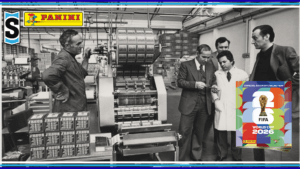
Panini has long held a unique position thanks to a simple, widely distributed and immediately understood product. The official World Cup album has operated for more than fifty years on an elementary mechanism: completing a collection before and during the tournament. This model allowed the Italian publisher to reach well beyond specialist collectors. Children, parents, occasional supporters, football fans mobilized by their selection: the World Cup transformed a printed product into a repeat purchase, installed in schoolyards, offices, local shops and supermarket shelves.
 FIFA is now entrusting this asset to a partner built on a different logic. Fanatics is not only arriving with Topps, the historic brand of collectible cards. The American group has a more integrated commercial chain, which covers licensing, retail, e-commerce, customer data, event products and premium collections. This approach corresponds to the current priorities of major rights holders: better identify fans, increase points of contact, personalize the offer, organize scarcity and extend monetization beyond the sporting calendar.
The deal includes physical and digital products. FIFA is also promoting cards incorporating elements of jerseys worn by players, including “debut patches”, these pieces associated with a first appearance or an identified moment in a career. The detail is revealing. Value is no longer based solely on the number of covers sold, but on the ability to create differentiated, authenticated, relatable and, for certain market segments, resellable objects. The official World Cup collection thus enters into a grammar closer to the premium trading card than to the popular sticker alone.
The real shortfall
For Panini, the loss is first and foremost strategic. The World Cup gave him worldwide authority in football collecting. Even when the publisher signed other competitions, other clubs or other championships, the World Cup remained its most readable asset. It established the brand in a territory that few rights can occupy: that of a family, global, periodic product, expected and immediately associated with the tournament.
The loss is also financial, even if FIFA and Fanatics have not communicated the amount of the new contract. ESPN, citing The Athletic, reports that Panini claims $720 million in net sales on products related to the 2022 World Cup and anticipates $1.48 billion in 2026 then $1.5 billion in 2030 on Mondial licensed products. These data should be read as reported figures, not as accounts published by Panini, but they give the order of magnitude of the file. After 2030, the Italian publisher will lose a rare, global commercial peak backed by the biggest footballing event on the planet. 
The World Cup has an advantage that is difficult to replace: it suddenly broadens the addressable audience. A national championship first works its regular followers. A club competition remains dependent on affinities by team, country or rivalry. The World Cup mobilizes a wider audience, made up of regular collectors, intermittent buyers and families who only enter this market as the tournament approaches. Panini mastered this shift from the general public to the act of collecting.
The 2026 edition further strengthens this potential. The increase to 48 teams and 104 matches increases the number of selections, players, national stories and markets that can be activated. For Panini, it will be the album of the biggest World Cup ever organized. For Fanatics, from 2031, this expanded format opens up a wider area: series by nations, limited cards, products linked to first appearances, operations around the stars, activations during the tournament, relaunches after major matches and commercial exploitation of unexpected courses.
The period 2026-2030 therefore becomes a delicate moment for Panini. The company will have to succeed in two major albums, including the centenary, while avoiding getting stuck in the register of the last lap. It has considerable brand equity, recognized editorial know-how and a still valuable distribution network. But it will have to demonstrate that the simplicity of its model can continue to produce value in a market now driven by scarcity, direct sales and community activity.
Fanatics installs its system
The choice of Fanatics is part of an offensive underway for several years. The American group bought Topps in 2022 and has secured several major rights in cards and collectibles, particularly in the United States. In European football, Topps has already replaced Panini as the exclusive licensee of UEFA for cards, stickers and albums for the men’s Euros 2024 and 2028, the women’s Euro 2025 and the final stages of the Nations League until 2028. ESPN also reports that Fanatics and Topps have signed or are to sign agreements with several national teams, including Argentina, Brazil, England, Germany and Italy, according to separate calendars.

This accumulation of rights is not a simple conquest of portfolio. Fanatics seeks to become the central operator of a market in which value is created as much in the commercial operation as in the manufacturing of the product. The group can sell a card, a premium box, a derivative product, a limited edition or a fan experience in a cohesive environment. For FIFA, which wants to maximize the commercial value of its competitions, this ability to activate the relationship before, during and after the event weighs heavily.
The relationship between Fanatics and FIFA was already underway before this agreement. The group is the official on-site retail operator for the 2026 World Cup, responsible for stores in the stadiums and around the 104 matches. The collectibles contract therefore extends a broader partnership. FIFA also says the agreement will see the distribution of more than $150 million in free collectible merchandise over the life of the partnership, with a component presented around the development of youth football. Commercially, this operation can also establish very early collecting habits around Topps and official FIFA products.
The risk for Panini is therefore not only to see Topps produce the next official album after 2030. It is to see Fanatics redefine market expectations. If the future holder of the FIFA license manages to combine general public stickers, rare cards, drops, direct sales, digital products, events and data exploitation, the comparison will no longer be made solely on the quality of an album. It will cover a complete experience, from the package purchased on impulse to the premium card presented as a collectible asset.
Panini retains important assets: a global reputation, an album culture, a strong presence in distribution circuits and an emotional relationship with several generations of consumers. But the planned loss of FIFA comes at a time of increased competitive pressure, particularly in the United States, where Fanatics has increased its rights acquisitions and where the two groups are already clashing in the legal field.
Alain Jouve

PakarPBN
A Private Blog Network (PBN) is a collection of websites that are controlled by a single individual or organization and used primarily to build backlinks to a “money site” in order to influence its ranking in search engines such as Google. The core idea behind a PBN is based on the importance of backlinks in Google’s ranking algorithm. Since Google views backlinks as signals of authority and trust, some website owners attempt to artificially create these signals through a controlled network of sites.
In a typical PBN setup, the owner acquires expired or aged domains that already have existing authority, backlinks, and history. These domains are rebuilt with new content and hosted separately, often using different IP addresses, hosting providers, themes, and ownership details to make them appear unrelated. Within the content published on these sites, links are strategically placed that point to the main website the owner wants to rank higher. By doing this, the owner attempts to pass link equity (also known as “link juice”) from the PBN sites to the target website.
The purpose of a PBN is to give the impression that the target website is naturally earning links from multiple independent sources. If done effectively, this can temporarily improve keyword rankings, increase organic visibility, and drive more traffic from search results.