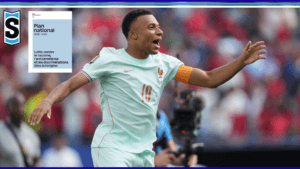
Competition folklore or match eve provocation? Neither one nor the other! In a few days, the French team was brought back to what racism regularly challenges it: its full belonging to the nation it represents. After the elimination of Paraguay by the Blues in the round of 16 of the World Cup, Paraguayan senator Celeste Amarilla published racist comments targeting Kylian Mbappé, to which the French captain responded publicly by denouncing “uninhibited racism”. The Paris prosecutor’s office opened an investigation, while the Paraguayan government distanced itself from comments deemed contrary to human dignity.
A few days later, as the France-Spain semi-final approached, Mariano Rajoy, former Spanish Prime Minister, in turn sparked a controversy by writing that France had a very high level squad, but “without French”. His successor Pedro Sanchez denounced “xenophobic statements”, recalling that some continued to measure belonging by family name, place of birth or skin color. In France, political and sporting reactions were immediate, including the president of the French Football Federation, Philippe Diallo, who denounced comments with “intolerable overtones of racism”.
These two episodes change the scale of the problem. Racism against French footballers is no longer just a matter of forums, online comments or anonymous accounts. It now appears in public speeches, made by elected officials or former heads of government, at the heart of the most watched sporting event in the world. The target is not only Mbappé, nor this or that player from real or supposed immigration. The target is the French team as the representation of a country which is defined politically by citizenship rather than by origin.
The 2026-2029 national plan gives, in this context, a particular resonance to this sequence. The document recalls that nearly 1.7 million French people are victims of racist, anti-Semitic or discriminatory comments or acts each year. It describes a logic of assignment which locks individuals into an identity, a real or supposed origin, a skin color, a fantasized belonging. What the Blues are experiencing on the world stage is therefore not a separate phenomenon. It is the overexposed, globalized and mediated version of a much broader social mechanism: challenging citizens for their full place in the national community.
A national asset under attack
For those involved in sport, this sequence forces us to move away from a purely moral reading. The French team is a sporting, media, commercial and diplomatic asset. It brings together global audiences, structures major partnerships, nourishes the value of the French Football Federation, strengthens the attractiveness of its players and contributes to the country’s international image. When foreign political leaders attack the Frenchness of the Blues, they are not only attacking individuals. They degrade a national symbol and target one of the most powerful sporting stories of the last thirty years: that of a selection capable of bringing together players with diverse social, territorial and family trajectories.
This point is essential: brands invest in football because it produces emotion, identification and narrative power. However, racist violence precisely contaminates this narrative. It transforms player exposure into vulnerability, popularity into risk, diversity into angle of attack. For a sponsor, a federation, a league or an equipment manufacturer, the fight against racism can no longer remain peripheral. It concerns the protection of talents, reputational security, the consistency of CSR commitments and the quality of the show offered to the public.
French football has long understood this through awareness campaigns. The 2026-2029 plan now pushes towards a more operational register. It plans to integrate the issues of racism, anti-Semitism and discrimination linked to origin into the training of referees and supervisors, to raise awareness among supporters with the professional leagues concerned, and to publish each year reports on disciplinary sanctions taken by sports federations for acts of racist, anti-Semitic or discriminatory hatred. This last measure could become a turning point if it is actually implemented. For what ? Because it introduces a culture of proof into a field too often dominated by occasional outrages.
The question now is whether French sport will be able to link its internal tools to a threat that goes beyond its borders. Faced with an identified supporter in a stadium, a federation can sanction. Faced with a licensee, a disciplinary commission can investigate. Faced with an online hate campaign, clubs can report, support and document. But faced with comments made by a foreign senator or a former prime minister, the response must also become institutional, diplomatic and legal. The Mbappé affair, with the opening of an investigation by the Paris prosecutor’s office, shows that the legal field can be mobilized. Pedro Sanchez’s reaction to Mariano Rajoy also shows that condemnation can come from within the very country where the attack originated.
From indignation to procedure
The DILCRAH report finds its interest in sport here: it does not only recommend condemning, it asks for organization. The plan emphasizes the clarification of the pathways for reporting online hatred, better coordination between platforms, PHAROS and Arcom, the consolidation of the Online Hate Observatory, the training of public actors and the territorialization of the fight against racism.
The difficulty, for the Blues as for the other exposed national teams, lies in the speed of attacks. A racist sentence pronounced or published abroad becomes in a few minutes a global topic, taken up by social networks, the media, political leaders, supporters and sometimes the opposing locker room. In this environment, statements of support are no longer enough. Sports institutions must have units capable of documenting the facts, protecting players, activating legal recourse, coordinating the response with public authorities and dialoguing with the platforms. Failing that, they leave the players alone to bear the emotional, media and political weight of the attack.
Mbappé occupies a unique position here. Captain of the French team, world star, commercial face of French football and one of the most influential athletes of his generation, he has an exposure that goes beyond the field. When he responds to Celeste Amarilla, he is not only defending his personal honor. He puts the responsibility where it lies: on the side of an elected official whose comments erased, through their violence, the sporting performance of her own selection. In this sense, his speech transforms crisis management into a political act. It also shows that players no longer want to be reduced to silent image supports when their dignity is attacked.
The Rajoy sequence confirms that the French team remains one of the great European mirrors of identity tensions. Since 1998, the Blues have been regularly used as a projection surface: celebrated as a symbol of unity when they win, contested in their composition as soon as the public debate becomes tense. The “without French” team formula uses an old mechanism. Namely, making the supposed origin a criterion of national legitimacy, as if the jersey, nationality, training, sporting commitment and personal history of the players were not enough. This is precisely what the national plan means when it speaks of assignment.
For the editorial staff of Sport Stratégies, the 2026 World Cup reveals that the fight against racism has become an issue of international sports governance. It concerns the rights of players, the value of competitions, the responsibility of federations, the security of sponsors, the credibility of institutional commitments and the capacity of sport to protect those who make up its economic power. In this context, the 2026-2029 plan is not another administrative text. It can become an action grid for French football confronted with a brutal reality (and for all disciplines, Editor’s note): the more the Blues win, the more their identity is attacked by those who refuse to see in this team a legitimate expression of France.
The challenge for the coming months will be to transform this sequence into a useful precedent. Not another controversy, quickly replaced by the next match, but a textbook case. The words of Celeste Amarilla and Mariano Rajoy show that racism in football is not just a drift of supporters. It can be formulated by political leaders, amplified by platforms, taken up in public debate and aimed at a national team at the very heart of what it represents.
It is up to French football to make the protection of its players a structured policy, and not an emergency reaction.
Alain Jouve
To download the report:
PakarPBN
A Private Blog Network (PBN) is a collection of websites that are controlled by a single individual or organization and used primarily to build backlinks to a “money site” in order to influence its ranking in search engines such as Google. The core idea behind a PBN is based on the importance of backlinks in Google’s ranking algorithm. Since Google views backlinks as signals of authority and trust, some website owners attempt to artificially create these signals through a controlled network of sites.
In a typical PBN setup, the owner acquires expired or aged domains that already have existing authority, backlinks, and history. These domains are rebuilt with new content and hosted separately, often using different IP addresses, hosting providers, themes, and ownership details to make them appear unrelated. Within the content published on these sites, links are strategically placed that point to the main website the owner wants to rank higher. By doing this, the owner attempts to pass link equity (also known as “link juice”) from the PBN sites to the target website.
The purpose of a PBN is to give the impression that the target website is naturally earning links from multiple independent sources. If done effectively, this can temporarily improve keyword rankings, increase organic visibility, and drive more traffic from search results.