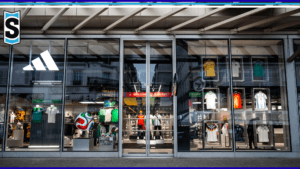
After the Champs-Elysées, adidas continues to densify its Parisian presence with a more compact, but very targeted format, in a district where residents, working people, tourists and fashion consumers meet every day. A few days before the start of the 2026 World Cup, the brand chose to back this opening with a very readable football sequence, highlighting the jerseys of its selections and several commercial activations designed to immediately create traffic.

A second Parisian act for the “Home of Sport” concept
A year after the highly commented opening of its Champs-Elysées flagship, adidas is extending its new interpretation of physical commerce to Paris. At Les Halles, the challenge is obviously not to reproduce the window effect of the most exposed avenue in the capital, but to install the brand in a more everyday point of contact, within a district which concentrates both passing power, fashion desirability and metropolitan centrality.
The choice of Les Halles is smart. The sector is one of the busiest in Paris, at the junction of shopping, restaurants, transport and destination uses. For a brand like adidas, which seeks to combine performance, lifestyle and urban culture, the address ticks several boxes at once: visibility, accessibility and proximity to a young target which makes the center of Paris a place of circulation as much as a place of consumption. The brand with the 3 stripes also insists on this equation between flow, fashion attractiveness and the intersection of Parisian and Ile-de-France mobility.
This new point of sale is also part of a logic of conceptual continuity. In May 2024, adidas inaugurated its largest European flagship on the Champs-Elysées, the first French version of the “Home of Sport” concept. This approach aims to bring together, in the same universe, the dimensions of performance, football, fashion and personalization, with a more experiential treatment of the store. Les Halles thus appears as a tighter extension of this strategy, adapted to a city center site with very high commercial intensity.
Football as a traffic accelerator
To launch its store, adidas chose an immediately readable angle: football. With the 2026 World Cup, the brand is devoting the entrance to the store to the competition and to the jerseys of the federations it equips, including Algeria, Spain, Japan, Colombia, Mexico, Argentina, Germany, Jamaica, Chile, Costa Rica and Belgium. The idea being to make this opening a commercial time connected to a major global event, in an area where international customers and communities of supporters are particularly present.
Activation doesn’t stop at merchandising. The “Made For You” space allows the personalization and flocking of jerseys, a service that is now central to conversion strategies in football categories. adidas is adding two promotional mechanisms on a national scale: a free Fennec plush toy, from June 13 and while stocks last, for the purchase of an Algerian Federation jersey, as well as a lottery organized from June 8 to 28 for any purchase of an adult jersey from an adidas federation, with a trip for two people to a semi-final of the 2026 World Cup.

The brand is also pushing a more local register with the “Génération Châtelet” program. Since June 6, an exclusive jersey produced in 300 copies has been sold in the store. Accompanied by a membership card, it gives access to discounts in the store as well as advantages at partner merchants in the area until July 19. The initiative is interesting in more than one way. Firstly because it territorializes the opening by anchoring it in a neighborhood image, and not in a simple logic of an additional store. Then because it reflects an evolution in sports retail: selling a product, of course, but also creating a circle of belonging, with scarcity, relational benefits and bridges with the local ecosystem.
A.J.
PakarPBN
A Private Blog Network (PBN) is a collection of websites that are controlled by a single individual or organization and used primarily to build backlinks to a “money site” in order to influence its ranking in search engines such as Google. The core idea behind a PBN is based on the importance of backlinks in Google’s ranking algorithm. Since Google views backlinks as signals of authority and trust, some website owners attempt to artificially create these signals through a controlled network of sites.
In a typical PBN setup, the owner acquires expired or aged domains that already have existing authority, backlinks, and history. These domains are rebuilt with new content and hosted separately, often using different IP addresses, hosting providers, themes, and ownership details to make them appear unrelated. Within the content published on these sites, links are strategically placed that point to the main website the owner wants to rank higher. By doing this, the owner attempts to pass link equity (also known as “link juice”) from the PBN sites to the target website.
The purpose of a PBN is to give the impression that the target website is naturally earning links from multiple independent sources. If done effectively, this can temporarily improve keyword rankings, increase organic visibility, and drive more traffic from search results.